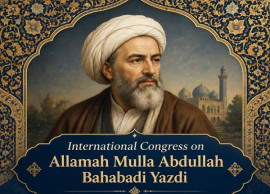
Due to the fact that "The Margin on the Old Margin of Devani on the New Description of Tajrid" is an explanation of one of the interpretations of "Tajirid al-Etiqad", in order to know it better and more, it is necessary and logical to read more about the original text, i.e. the book "Tajirid al-Itaqid". let's get acquainted
A note from Abdur Rahim Shahriari
In this note, an attempt has been made to analyze this book by focusing and emphasizing on the book of Allameh Bahabadi's margin on the old margin of Allameh Jalaluddin Mohammad Devani on the new description of Tajrid al-I'taqad by Khwaja Nasiruddin Tusi. Due to the fact that in order to understand any description or margin, it is logically necessary to pay attention to the text of the original book on which the description is written, this note also briefly introduces the abstraction of belief of Khwaja Nasir al-Din Tusi and has a look at it. To the structure and chapters of abstraction of belief. In the following note, the scientific importance of the abstraction of belief is mentioned, and because of this importance, many explanations have been written on it. This note mentions the names of some of these explanations and margins. Then, the formal issues and details related to the existing version of "Hasiyeh on the old margin of Devani on the new description of Tajrid" in the library of the late Ayatollah Seyyed Shahabuddin Murashi Najafi in Qom city have been examined. In the continuation of this article, a deeper opinion has been cast on the content of this book and an attempt has been made by stating the evidence and proofs, in addition to examining the writing style of Allameh Bahabadi in this book, his points of view and the issues that he stated in his book. is to be mentioned. His philosophical and jurisprudential approach in expressing and proving theological issues, his scientific method in observing the principles of logic in expressing scientific content and arguments, the accuracy of Allameh Bahabadi's opinion in examining and analyzing various and diverse points, the breadth of the topics examined, and in His ultimate critical method in dealing with the topics and issues raised are all among those that form the methodological and content characteristics of Allameh Bahadi in scientific studies, especially in this valuable book.
Mullah Najmuddin Abdullah bin Shahabuddin Hossein Bahabad of Yazdi is one of the great scholars and Jalil-ul-Qadr Shiite scholars who set foot on this earth in Bahabad of Yazd in the early 10th century of Hijri. He is known as the author of Taftazani's famous margin because of his lasting and weighty work, "Al-Hashiya Ali Tahzeeb al-Muntiq al-Taftazani" (1) (known as Mullah Abdullah's margin), which is the result of his reflections and meticulousness about the book "Tahzeeb al-Muntiq" (2) Is. "Al-Hashiya Ali Tahzeeb al-Muntiq al-Taftazani" by Mullah Abdullah has been well established as a textbook in Shia seminaries for many years due to the depth of the content and the eloquence of expression and the use of a remarkable scientific style and method. And clerics and students of religious sciences get to know the subtleties and subtleties of the science of logic through the book of Malabullah's margin. But the greatness of this work should not prevent us from knowing other works of Mulla Abdullah, each of which represents one of the existential dimensions of this metal world.
From Mullah Abdullah Bahadi, so far, about twenty books in Arabic and Persian have been identified and have reached the hands of the Taliban of knowledge and knowledge, each of which is remarkable and studied and accurate in its field, and each of them has been able, in turn, in the field The science in question will help to advance the religious knowledge of Shia in general, and in particular, give remarkable and unique help to the clerics and students of seminaries to learn Islamic sciences.
Among these diverse and valuable works, which include logic and philosophy, jurisprudence, the principles of jurisprudence, interpretation of the Holy Quran, and the science of meanings and expression, the book "The Margin of the New Description of Abstraction (known as the Margin of Old Dewani)" (3) or in other words, "the margin on the old margin on the new description of abstraction" which is one of its noble works is remarkable in several ways. This book is a commentary written by Allameh Bahabadi on Allameh Devani's commentary on "Tajreed al-Itqad" (4) by Khwaja Nasir al-Din Tusi (died 672). The great and long-lasting book Tajrid al-Etiqad has also been called by other names such as "Tajirid al-Aqeed" and "Tajirid al-Kalam". But Agha Bozur Tehrani in his book "Al-Zariyah al-Tsanif al-Shia" (5) believes that the original name of this book was "Tahrir Al-Aqeed".
Due to the fact that "The Margin on the Old Margin of Devani on the New Description of Tajrid" is an explanation of one of the interpretations of "Tajirid al-Etiqad", in order to know it better and more, it is necessary and logical to read more about the original text, i.e. the book "Tajirid al-Itaqid". let's get acquainted
"Tajreed al-Etiqad" is one of the authentic Shia books, which was written in the 7th century of Hijri on theology and beliefs of Shia.
The structure of this book as well as the way of dealing with the topics in it are interesting. This very prominent and solid theological book has six "maqqas" that is, six sections or chapters.
These six "destinations" are:
The first destination in public affairs,
The second destination in Jawaharlal Nehru,
The third goal is to prove the creator and his attributes.
The fourth destination in prophecy,
The fifth destination in Imamat
And the sixth or final destination in resurrection.
The first and second destinations, i.e. public affairs and jewels and symptoms, have dealt more with the issues raised in the first philosophy. The reason for this is that public affairs, jewels, and diseases are among the basics of theological debates.
One of the interesting points about this book is that this work, despite its mastery and strength of content, is very brief to the extent that it is considered the most concise and concise Shia theological text.
These matters, i.e. mastery, in their brevity, have caused many notes and explanations to be written on this treatise in Persian and Arabic languages.
It is well-known that the first description of Tajrid was written by the most famous student of Khwaja Nasir Tusi, Allameh Halli, and he called it "Kashf al-Murad fi Sharh Tajrid al-Itqad" (6).
Some other famous interpretations of "Abstraction of Belief" are:
"Tsedid or the construction of rules in the description of abstraction of beliefs", (7) known as "Sharh al-Qadim", by Shams al-Din Mahmoud bin Ab