
Picture: The Chairman of the International Congress of Allameh Bahabadi, Dr. Hasan Abdipour, presents their recent publications to the Head of the Supreme Assembly of Islamic Philosophy, Ayatollah Fayazi.
The Contribution of the Supreme Assembly of Islamic Philosophy to the International Congress of Allameh Mulla Abdollah Bahabadi Yazdi
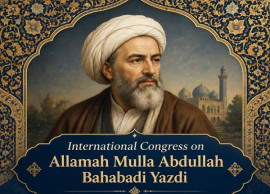
The Supreme Assembly of Islamic Philosophy (SAIP) is contributing to the International Congress of Allameh Bahabadi which has been in progress since 2023. The congress is conceived in memory of Allameh Mulla Abdullah Bahabadi Yazdi, the 16th-century Iranian logician, philosopher, and Islamic jurist who also served as the trustee of Imam Ali Holy Shrine as well as the de facto governor of Najaf Holy City in modern-day Iraq when it was part of the Safavid kingdom in Iran. Mulla Abdullah's magnum opus in logic, called "Al-Hashieh", has been the main textbook of logic in both Shia and Sunni Islamic schools for nearly 400 years. This makes Mulla Abdollah, a truly international figure with the potential to be promoted as a global figurehead of the prime Shia school of thought in the 16th century AD on par with thinkers who lived around the same time in the West.
In April 2024, a special book launch ceremony took place at the SAIP headquarters in Qom during which the Executive Director of the SAIP, Mohammad Bagher Khorasani, the Chairman of Allameh Bahabadi Congress, Dr. Hasan Abdipour, a faculty member of Imam Khomeini's Educational and Research Institute, Dr. Askari Soleimani Amiri, and the Head of Al-Hoda Center for Seminary Studies in Iraq, Dr. Sadegh Al-Hashemi, participated to reveal the newly published bilingual (i.e. Persian and Arabic) collection of essays on the life and work of Allameh Bahabadi and share their thoughts and experiences on the matter of managing such international congresses.
During the meeting, Khorasani emphasized the fact that reviving the legacy of Iranian Islamic thinkers in the fields of philosophy, theology, mysticism, and epistemology is part of the SAIP mission. He thanked the organizers of Allameh Bahabadi Congress for their effort in reintroducing Allameh Bahabadi's work into the humanities community while sharing some of his own organizing experience regarding Allameh Tabatabaei Congress including holding several preliminary international sessions on Allameh Tabatabaei's Quranic and philosophical works in Iraq.
Dr. Sadegh Al-Hashemi elaborated on the reasons and justifications behind the project to revive Allameh Bahabadi's legacy. He also mentioned that the lack of translations of some of Allameh Bahabadi's Persian works into Arabic and other languages, is one of the challenges to be addressed by the congress officials. He stated that, more generally, the lack of translation of Iranian scholars' works into Arabic hampered the accessibility of these texts in Arab countries. Thus, founding a professional translation center for translating the Islamic jurisprudence courses of the Iranian prominent seminary scholars such as Imam Khomeini, Imam Khamenei, and other grand ayatollahs seems to be necessary. Otherwise, the vast Shiite school of thinking will be restricted to the geographical and linguistic boundaries of Iran.
Hashemi also pointed out that more than 76 grand religious scholars immigrated from Iran to Najaf in Iraq. He encouraged the SAIP not to restrict its project of reviving Shia thinkers to the case of Allameh Bahabadi and added that the perspective of other Shia scholars should be considered as well.
He emphasized that the American, British, and Zionist centers and think tanks operating in Islamic countries, including Iraq, are established to distance the people from the ideology of the Ahl al-Bayt (peace be upon them). He stated that Western civilization intends to confine the Shia ideology to the geography of Iran and present the school of Ahl al-Bayt (peace be upon them) as an Iranian school among the youth and teenagers. He appreciated the efforts of the SAIP and expressed: "Expanding and introducing the achievements of the SAIP beyond the borders of Iran is very important and necessary." He emphasized the importance of strengthening the connection between the scientific and research centers of Qom and Najaf seminaries too.
Also, Hujjat Al-Islam Soleimani referred to the expansion and development of rational sciences in Iran and expressed: ''Rational discussions are among the weaknesses and challenges of the Shia seminaries in other Islamic countries; if there had been no attention to rational discussions, works like Our Philosophy and Our Economy by Martyr Sadr would not have been produced.'' He considered the transmission of the culture and ideology of the Ahl al-Bayt (peace be upon them) to Islamic lands through local languages and dialects very important and noted: 'The translation of esteemed Islamic texts into Arabic requires translators who are familiar with the structures of the Persian language and the diverse dialects of Arabic-speaking countries.' He emphasized that training international student translators in rational sciences from among the volunteers of various Islamic countries is one of the ways through which the thoughts of top scholars can be conveyed to others.'
Furthermore, at a subsequent meeting in May 2024, which took place at the SAIP headquarters in Qom, the Head of the SAIP, Ayatollah Gholam Reza Fayazi, received a delegation of Allameh Bahabadi Congress officials including the Chairman of the Congress, Dr. Hasan Abdipour, the Director of Foreign Affairs of the Congress, Dr. Ali Sadegh Daghighi, the representative of the Iranian Institute of Philosophy at the congress, Dr. Mohammad Jafar Jame Bozorgi, and the Director of Manuscripts at the Congress, Hujjat Al-Islam Dr. Akbar Asad Alizadeh, to discuss further avenues of collaboration between the SAIP and Allameh Bahabadi Congress.
During this meeting, the members of the congress steering committee presented brief reports on the accomplished works and projects at hand including publishing relevant collections of articles about Mulla Abdullah, organizing preliminary sessions in Iran and Iraq, producing documentaries and educational animations for children, negotiations with the UNESCO National Committee to register Allameh Bahabadi as the Iranian cultural figure of global significance, searching for rare manuscripts of Allameh Bahabadi in public and private collections of Iran, Iraq, Turkey, Egypt, India, Britain, Italy, Vatican, Russia, and the United States.
In return, Ayatollah Fayazi also expressed his praise and gratitude towards the members of the steering committee of the Allameh Bahabadi Congress for their effort in the direction of reviving Mulla Abdullah's legacy in the contemporary research community.
In the end, a newly published collection of articles related to Allameh Bahabadi was revealed.