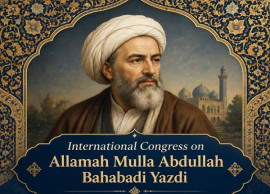

Dr. Ali Sadegh Daqiqi Topic: Necessity of Globalizing the Personality of Allameh Bahabadi
In the name of Allah, the gracious and merciful,
Greetings to all my friends and colleagues who attended this meeting and thanks to the organizers especially reverend clergymen, Dr. Ghzanfari and Dr. Lak, and the secretary of the International Congress of Mulla Abdullah Bahabadi Yazdi, Dr. Abdipour, who allowed me to represent the office of the international affairs of the congress in which I have the honor of serving under his supervision.
My background is in mathematical logic, especially set theory, which deals with questions in the foundation of mathematics which of course is rooted in and related to the traditional logic that came from Aristotle and later was explored and expanded by Muslim scholars such as Avicenna and Mulla Abdollah, the prominent 16th century logician and politician whose rule on Najaf and works in logic and Islamic law is revered by contemporary experts.
Today I am going to talk about the necessity of expanding the global recognition of Mulla Abdollah who unfortunately is not as well-known as he should be even in Shia Islamic circles in Iran let alone in other Islamic countries and around the world.
As you possibly know, Molla Abdullah's seminal work in logic, called Al-Hashieh, has been the sole textbook of logic in both Shia and Sunni Islamic schools for nearly 400 years.
This makes Molla Abdollah a truly international figure with the potential to be promoted as a global figurehead of the prime Shia school of thought in the 16th century AD on par with thinkers such as Descartes who lived around the same time in the West.
We at the Office of Foreign Affairs of the Congress devised a few plans on how to achieve this goal. For instance, we are planning to convince the United Nations Educational, Scientific, and Cultural Organization (UNESCO) to designate Mulla Abdollah's character and legacy as part of the Iranian cultural and scientific heritage which opens the door for future international promotion of his life and career on the global stage. We also might be able to negotiate our way towards convincing UNESCO to dedicate a specific year to Mulla Abdollah which in turn furthers the cause.
For those who know, this is not an easy undertaking as lots of diplomatic considerations come into the play in such matters of global interest which itself is a function of the global geopolitical situation.
On another front, my colleagues and I are working tirelessly on finding and evaluating all the manuscripts attributed to Mulla Abdollah scattered around various public and private libraries and collections in and out of Iran including in Iraq, Turkey, Egypt, Vatican, France, Britain, Germany, and the United States.
Also, we are going to translate parts of Mulla Abdollah's writings into English and other languages to spark scientific conversation in the West which itself may lead to joint comparative scientific papers by Iranian and Western scholars.
With the help of our sponsors, we also plan to establish an international prize in honor of Mulla Abdollah to be awarded to any Iranian or non-Iranian researcher who conducts high-quality research on Mulla Abdollah's scientific legacy and social impact.
Last but not least is the political agenda attached to the whole affair which is connected to the broader cultural message of the Islamic Republic of Iran proclaimed by the Iranian supreme leader, Ayatollah Khamenei, time and time again.
The point is that the rise of the global south and the decline of the Western-dominated hegemony which dates back to the Renaissance brought much-needed attention to the cultural and scientific heritage of the non-western civilizations including the Islamic civilization at the pinnacle of which sits Shia and Iran as the crown jewel of the Islamic world.