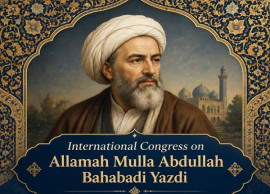

Ayatollah Dr. Seyyed Mostafa Mohaghegh Damad stated during a meeting with the members of the Secretariat of the Allameh Bahabadi Yazdi Congress: “People in our time have become more rational, which has made the mission of intellectuals even more important.”
Regarding Mulla Abdullah Bahabadi Yazdi, he remarked: “I was not aware that Mr. Mulla Abdullah Bahabadi was also a jurist; therefore, it must be said that we Yazdis are underappreciated in introducing and recognizing our scholars and intellectuals, as there are many scholars and thinkers who go unmentioned.”
One of these scholars is Muhammad Baqir Sharif Ardekani (1231-1301 AH), the author of the book “Jami’ al-Shawahed.” His book is one of the literary works of the Qajar era, in which the author translated selected Arabic poetry.
Another scholar is Abu Tahir Majd al-Din Muhammad Firuzabadi (816-729 AH), a lexicographer and Iranian writer originally from Firuzabad, Yazd, not Shiraz.
Another scholar is Qazi Kamal al-Din Meybudi, the author of “Sharh Hidayat al-Hikmah,” who stands out in the scientific and literary landscape of the 9th and 10th centuries AH. This book is one of the important legacies and sources of Islamic philosophy and wisdom, where Meybudi presents his specific critiques, playing a significant role in the evolution of Islamic philosophy and bridging various intellectual paradigms of his time. He also became an inspiration for Sadr al-Mutalehin Shirazi in the emergence of Transcendent Philosophy.
The few scholars I mentioned are examples of the lesser-known intellectuals of Yazd. Mulla Abdullah Bahabadi Yazdi is also recognized primarily as the author of the glosses, creating obscurity in other fields of knowledge.
The Relationship Between Mohaghegh Karaki and the Safavid Shiite State
Mohaghegh Karaki served as the official Sheikh al-Islam of Iran during the reign of Shah Abbas Safavi. He fully strengthened the power of the Safavid Shiite state and accomplished many tasks; one of them was organizing the judiciary and establishing a network of judges across the country to adjudicate based on Shiite jurisprudence. He also expanded religious schools in Iran.
Mulla Abdullah Yazdi was a philosophical thinker with socio-political implications. Some Yazdi scholars were reclusive, but Allameh Mulla Abdullah Bahabadi was not withdrawn. The path of collaboration between the scholars and the Safavid state was resolved by Mohaghegh Karaki, who redefined the theory of collaboration with the government and effectively addressed the political challenges faced by scholars regarding non-infallible government. Mulla Abdullah lived in the same era and, as his student, fell in line with his political stance.
I recall an important account, either from the late Mulla Ali Modarres Zenoozi or something I read in the margins of Kifayah, that Mohaghegh Karaki coordinated with Shah Ismail to travel to all cities and review the rulings of judges, confirming those who rendered good judgments while removing those who did not perform well.
During a visit to Kashan, Mohaghegh Karaki observed that very precise and excellent judicial rulings had been issued. He inquired about the identity of the city’s judge. Upon bringing him forward and questioning whether he had studied jurisprudence in Najaf, he replied no. When asked if he had studied in Khorasan, he replied no. Then he asked if he had studied in Isfahan, to which he also answered no. When asked where he had learned jurisprudence and how he issued such correct rulings, the judge replied that he based his judgments on reason. Mohaghegh Karaki recorded this in his “Jami’ al-Maqasid.” This judge was the eminent scholar Mohaghegh Khafri.
In “Jami’ al-Maqasid,” Mohaghegh Karaki states that it was after this that we introduced the principle “Whatever is ruled by the Shari’ah is also ruled by reason,” which we emphasize.