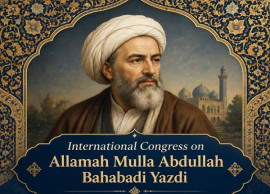

Hojjatoleslam Dr. Seyyed Ali Hosseinizad; Vice President of Research at the Research Institute of Quran and Hadith:
More importantly than understanding Allameh Mulla Abdullah Bahabadi as an individual detached from context, we need to recognize that he exists between two intellectual civilizations: one being the Shiraz School, represented by figures like Dashtaki and Davani, and the other being Qazvin and the Najaf School during the time of the sacred Ardebili (Mulla Abdullah was present in both the Shiraz and Najaf schools).
The Safavid period is a historical phase of transformation in Shia Islam, during which Shia gained political power. If we can effectively capture the atmosphere of that era, it would be a significant achievement. Another important issue is the deficiencies concerning Allameh Mulla Abdullah Bahabadi, his works, and the Shiraz School.
This historical period, apart from prominent figures like Mohaghegh Karaki, Mulla Abdullah, and Sheikh Bahai, is also characterized by numerous handwritten manuscripts. The Dashtaki family has not had their works revived, primarily due to a lack of engagement with the theological and philosophical discussions of the Shiraz School. It is essential to elucidate the culture and politics of that time; for example, we should investigate how traditional titles and terms used in scholarly circles in the 10th century were defined, and specifically, for whom the term “Mullah” was used. At that time, the title “Mullah” was conferred upon those at the pinnacle of scientific achievement. Therefore, understanding the cultural context and the intellectual traditions of the Shiraz and Qazvin schools requires thorough investigation.
We have conducted research and published books on the schools of Hilla, Isfahan, Baghdad, and Medina; however, researching the Shiraz School is challenging because the manuscripts from that era are still handwritten. Another reason is that the Shiraz School inherits an Ash’ari philosophical legacy, even though it later became Shia.
Seyyed Nematollah Jazayeri states in his book “Al-Anwar al-Ni’maniyyah” that the Safavid establishment summoned Allameh Khafri and asked him to declare his disassociation, which he did more strongly than the others.
Therefore, during that time, he and some others became Shia, but they retained a completely philosophical Ash’ari legacy. Although the Dashtakis in Shiraz were Shia, the culture of the Shiraz School was predominantly Sunni prior to the Safavid state. This school coincided with the era of scholars from the Jabal Amel School. As a result, this period marks the convergence of the great Shia civilization; thus, if the secretariat of the International Congress of Allameh Mulla Abdullah Bahabadi can research the Shiraz School or the Qazvin School or the Isfahan schools, they will fill a gap. The intellectual schools of Shiraz and Qazvin lie between the Hilla and Isfahan schools, and this historical period is crucial. If this project is executed, it will provide a better understanding of the cultural and temporal context in which Mulla Abdullah existed. This period is very significant politically, socially, and culturally; therefore, if we wish to introduce Allameh Bahabadi to contemporary society, we must clarify the status of his time from an academic and cultural perspective.
He expressed the readiness of the Research Institute of Quran and Hadith to hold sessions, compile articles, and engage in joint projects.
The entire cooperation and support from great figures such as Mohaghegh Karaki and Allameh Mulla Abdullah Bahabadi Yazdi with the Safavid government were rooted in the reinforcement of Shiism. Despite the weaknesses in the Safavid era, individuals like Shah Ismail sacrificed for the establishment of Shiism.
Just as Khwaja Tusi referred to Allameh Hilli as “Allameh,” Sheikh Baha’i also used the title “Allameh” for Mulla Abdullah Bahabadi Yazdi.
It should be noted that without the rationality of Shi’ism and the intellect of scholars like Avicenna and Khwaja Nasir al-Din Tusi significantly influencing jurisprudence and principles, we in the Islamic world would have thought like ISIS.