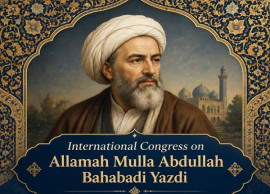
Dear brothers and sisters welcome to our second autumn school. We are going to talk about some aspects of Allahmah Bebahadi Yazdi but first of all I would like to draw your attention to a verse from the Quran and we are going to take benefit from this verse and also, we will be discussing about some points that might be neglected or ignored in previous session. And first I would like to start with sura al-Hamd.
بِسْمِ اَللّٰهِ اَلرَّحْمٰنِ اَلرَّحِيمِ
Moderator
0:01:06.6
اعوذ بالله من الشیطان الرجیم بسم الله الرحمن الرحیم الحمد لله رب العالمین و صلی الله علی محمد و آله الطاهرین
الّلهُمَّ صَلِّ عَلَی مُحَمَّدٍ وَ آلِ مُحَمَّدٍ و عَجّل فَرَجَهم
Dear brothers and sisters welcome to our second autumn school. We are going to talk about some aspects of Allahmah Bebahadi Yazdi but first of all I would like to draw your attention to a verse from the Quran and we are going to take benefit from this verse and also, we will be discussing about some points that might be neglected or ignored in previous session. And first I would like to start with sura al-Hamd.
اعوذ بالله من الشیطان الرجیم بِسْمِ اَللّٰهِ اَلرَّحْمٰنِ اَلرَّحِيمِ
اَلْحَمْدُ لِلّٰهِ رَبِّ اَلْعٰالَمِينَ اَلرَّحْمٰنِ اَلرَّحِيمِ مٰالِكِ يَوْمِ اَلدِّينِ إِيّٰاكَ نَعْبُدُ وَ إِيّٰاكَ نَسْتَعِينُ اِهْدِنَا اَلصِّرٰاطَ اَلْمُسْتَقِيمَ صِرٰاطَ اَلَّذِينَ أَنْعَمْتَ عَلَيْهِمْ غَيْرِ اَلْمَغْضُوبِ عَلَيْهِمْ وَ لاَ اَلضّٰالِّينَ
Please recite another Salawat.
الّلهُمَّ صَلِّ عَلَی مُحَمَّدٍ وَ آلِ مُحَمَّدٍ و عَجّل فَرَجَهم
There is an ayah in surah Mujadilah this is verse number 11 which Allah the almighty says:
اعوذ بالله من الشیطان الرجیم
يٰا أَيُّهَا اَلَّذِينَ آمَنُوا إِذٰا قِيلَ لَكُمْ تَفَسَّحُوا فِي اَلْمَجٰالِسِ فَافْسَحُوا يَفْسَحِ اَللّٰهُ لَكُمْ وَ إِذٰا قِيلَ اُنْشُزُوا فَانْشُزُوا يَرْفَعِ اَللّٰهُ اَلَّذِينَ آمَنُوا مِنْكُمْ وَ اَلَّذِينَ أُوتُوا اَلْعِلْمَ دَرَجٰاتٍ وَ اَللّٰهُ بِمٰا تَعْمَلُونَ خَبِيرٌ
‘O you who believe! when it is said to you, Make room in (your) assemblies, then make ample room, Allah will give you ample, and when it is said: Rise up, then rise up. Allah will exalt those of you who believe, and those who are given knowledge, in high degrees; and Allah is Aware of what you do.’
So, let’s start with our discussion. We are in the presence of some of the scholars, masters from different institutions. We are in presence of first of all Dr. Muhamad Taqi Eslami, the faculty member of Islamic Sciences and Culture Academy and also, we have Dr. Sayyid Hamed Alizadeh Musawi and he is also from the same academy I mean the faculty member of Islamic Sciences and Culture Academy and also, we are in the presence of another Dr. she is Dr. Muhammadi Kia. She is the faculty member of the Institute for Humanities and Cultural Studies and the topics will be number 1: Dr. Eslami talks about this matter I mean ‘How Muslim Philosophers Derived Ethical Proofs as seen in the Academic Works and Moral Conduct of Allahmah Behabadi Yazdi’. And second, we will go and shift to Dr. Sayyid Hamed Alizadeh Musawi and the topic is ‘The Quranic Exegetical Method of Allahmah Behabadi Yazdi’. And at the end we will be discussing and talking about the topic of Dr. Muhammadi Kia and that is ‘Allahmah Bebahadi’s Comprehensive Understanding of the Intellectual and Transmitted Sciences’.
So, we will start and go one by one to talk about these points and if there is anything if there is any question, because this session is going to be held in person and online so if there is any question and comment you can send them to us and we are in the presence of Dr.s and will ask them about the points; and if there are something missed or misunderstood. And first of all, I would like to ask Dr. Mohamad Taqi Eslami to start his discussion and we will take benefit from the points that he is going to explain and go to the details because in the first session we discussed some aspects of Allahmah Bebahadi but right now we are going to details and to know more about the points might be neglected. So, we start with Dr. Eslami after reciting Salawat Ala Muhammad Wa Ale Muhammad.
الّلهُمَّ صَلِّ عَلَی مُحَمَّدٍ وَ آلِ مُحَمَّدٍ و عَجّل فَرَجَهم
Dr. Muhammad-Taqi Eslami
0:05:44.1
بسم الله الرحمن الرحیم
و صلی الله علی سیدنا محمد و آله الطاهرین
Thank you, brothers and sisters, who are present here and … from out of the place. My presentation is about “The Stylistics of the Ethical Justification and the Moral Reasoning from the view point of Hakim Behabadi Yazdi”.
I prepared some pages some papers some essays in 5 parts and I shall read it and after my reading if there is any question, I will be ready to answer them if I can.
0:06:59.2
The Stylistics of Ethical Justification and Moral Reasoning
From the Viewpoint of Hakim Behabadi of Yazdi
Mohammad-Taghi Eslami; Islamic Sciences and Culture Academy (ISCA) in Qom-Iran
1
Today, applied ethicists introduce three methods of justification and reasoning to prove moral judgment: the top-down method, the bottom-up method, and the reflective equilibrium method.
The top-down method is a logical, deductive method. Deduction is the same method used in the mathematical sciences. In the deductive method, certain propositions contain premises. In this method, moral theories are expected to play the role of certain premises to prove moral judgments. But none of the moral theories can provide a certain predetermined structure to prove any moral judgment; a structure that can act like a mathematical rule in ethics and be equally applicable to all cases. The first problem with moral theories is that they are abstract and cannot cover all the objective and concrete details in a moral event. This problem has led many researchers in applied ethics to abandon the reference to ethical theories and to adopt an anti-theoretical approach and to turn to the bottom-up method.
The bottom-up method is a logical-inductive method. Logical-inductive method is the same method used in experimental science. Inductive reasoning consists of empirical premises, and its result is not certain. This method does not refer to a predetermined theory or theoretical structure. This method is completely based on the results obtained from the study of cases, and the verdict obtained as a result is completely partial, and the verdict of each case is different from another case. It is clear that if there is no previous theoretical structure to evaluate and measure the judgment of cases, and if the judgment of each case is completely subject to the conditions and contextual characteristics of that case, then we will never have an absolute moral judgment, and morality will always be relative. So the bottom-up method leads to the moral relativism. Moral relativism is a theory that has many problems.
Thus, the top-down method suffers from forms of abstraction, and the bottom-up method confronts us with moral relativism. What to do now, and what method to use? Is there a third way?
Here, thinkers have invented a third method that thinks about the thoughtful balance between high and low, that is, it thinks about multiplying the results of paying attention to moral theories according to the conditions and background characteristics of each specific case. This method is called moral principlism.
2
All moral principlists consider existing moral theories to be too abstract and therefore unworthy of central importance in moral reasoning, but none of them avoid these theories altogether. Some try to provide a correct interpretation of deontological or consequentialist theories, and some find it useful to combine and complement different theories. The result of this interpretation or combination is the integration and completion of moral principles. These principles, rather than moral theories, are the cornerstone of moral reasoning. Principles such as charity and justice.
3
About the justification basis of moral principles: a group of principlists justify moral principles based on human reason and nature; This group pays little attention to the role of history, social contract, tradition, customs and the like in justifying moral principles. But another group of principlists consider the basis of the justification of moral principles to be "common morality" which pays basic attention to the role of history, social contract, tradition, customs and the like.
Now the question arises, where did we get these moral principles?
To answer this question, we inevitably enter into meta-ethical discussions about the meaning and justification of moral propositions. Philosophers such as William Frankena, in the theorizing of normative ethics, ultimately prove that their unbiased attempt to arrive at a relatively stable theory does not come to an end. In fact, this proof provides the basis for the hypothesis that even if moral propositions tell us about a reality, this reality is not a merely descriptive reality that can be obtained in the form of descriptive theories; rather, the recommending or guiding element in these propositions plays a central and consistent role.
If this hypothesis is proved, it turns out that the reasoning process for justifying moral propositions is fundamentally different from the reasoning process in other sciences; here we are dealing with a different kind of reasoning: if one base of this reasoning is based on a descriptive fact (and indicates what is), the other base must be based on a recommending fact (and indicates what ought to be). There is no logically productive relationship between descriptive facts and moral do's and don'ts: Between is and ought. Although we should not deny that other kinds of logical relations are in the place.
4
Western moral philosophy and applied ethics texts (as far as the author has searched) have not addressed the question of the nature of such reasoning. However, Muslim sages and logicians, where they have discussed in detail the types of logical reasoning, have considered moral propositions such as the commonly accepted ones that constitute the premise of polemical reasoning. Polemical reasoning is reasoning based on facts or statements which are intended to oblige or inform the opponent. It should be noted that polemical reasoning is not a fallacy even if it is not an argument based on certainty (Burhan).
There has been a discussion among Muslim scholars about the evidential nature of moral issues, and some of them have believed that moral issues have not certain evidences, but rather they have special, commonly accepted ones (Mashhuorat Khasse). Perhaps it can be assumed that the thought of how to solve moral problems, as well as the challenges and deadlocks that existed in explaining and clarifying moral propositions based on general and total theories, led these scholars to this belief. Anyway, those who consider moral issues to have commonly accepted reasoning can show interest in case studies and contextualized approaches. While those who believe in the evidential nature of moral issues, if they do not reject case studies and contextualism, will at least look at them with caution.
Following the thought of Muslim scholars who have considered moral rules not from proofs, but from common knowledge, leads us to believe that their position is in fact in line with the answer to the question of the meaning and justification of moral propositions and rules, which is considered a meta-ethical discussion.
The theory of moderate moral recommendation is very close to the theory of these Muslim scholars. Although the discussion of applied ethics methods is in the field of normative ethics, not meta-ethics, it is necessary to discuss the meta-ethical principles that govern these methods. Adopting a recommendatory basis along with popular knowledge of ethical issues strengthens the evidence base for the use of case studies and reflective equilibrium.
5
Muslim scholars often consider moral propositions to be special, and in this way they consider moral reasoning not in the line of argumentative arguments, but in the line of polemical arguments. This point is reflected in the logical works of the sages, especially in the topic of Sanaat Khams, which is devoted to the methodology of various types of logical arguments. It is surprising that this very important topic was neglected by the late logicians and according to Hakim Bahabadi in his comments on the book of Tahthib al Mantigh, the expression of the late scholars on this topic was infected by a disturbing brevity. This brevity and the neglect of accurate and precise elaboration have become an excuse for critics who have not made sufficient efforts to understand this topic, and have criticized the sages and logicians that the style of moral reasoning they have considered leads ethics to the abyss of relativism. While this criticism is not correct, and we can, inspired by the hints of sages such as Hakim Bahabadi, uncover the ambiguity of the stylistics of moral reasoning desired by Muslim sages and reveal the conclusion that the popularization of moral propositions not only has nothing to do with moral relativism, but it is in harmony with the reality of man's moral life. The discovery of this harmony and its application has brought fruitful results in the practical life and moral conduct of the sages whose lives we have in the biographies of Islamic scholars. Hakim Mulla Abdullah Bahabadi of Yazdi is one of the leaders of these sages.
Thank you so much.
Moderator
23:21
Thank you very much for your very informative points and your topics that you mentioned here, but right now we are going to shift to Dr. Sayyid Hamed Alizadeh Musawi and the topic is ‘The Quranic Exegetical Method of Allahmah Behabadi Yazdi’. We start, we are going to take benefit from the points you are going to mention here and get ready for the presentation.
Dr. Alizadeh Musawi
24:1
بسم الله الرحمن الرحیم
و به نستعین فانه خیر ناصر و معین و الصلاة و السلام علی سیدنا و نبینا ابی القاسم المصطفی محمد اللهم صل علی محمد و آل محمد و علی آله الطیبین الطاهرین المعصومین
Thank you, very much dear brothers and sisters; and also thank you dear professor Eslami for informative lecture about Allame Behabadi and thank you dear Dr. Abdi pur for arranging this meeting and Alhamdulillah this is very precious work that you do for Allame Behabadi and I hope inshallah this services that you are making gives us very informative information about these ulama and these scholars in Islam.
So, my topic as dear brother Mr. Ghazanfari said is about the Manhaj or the method of Allame Behabadi’s interpretations and commentary of the Quran and for reaching to understand what is the method of Allame Behabadi in commentary of the Quran and the interpretation of the Quran.
We have to know what are these methods and these tendencies? What are the methods and tendencies in the interpretation of the Quran? As you know, the interpretation of the Quran and the commentary of the Quran started from the beginning of the Islam and the revelation of the Quran. So, the first interpreter of the Quran is prophet Muhammad صلی الله علیه و آله و سلم . And we have this fact in the Quran, in many verses of the Quran for example Allah سبحانه و تعالی says:
وَ أَنْزَلْنٰا إِلَيْكَ اَلذِّكْرَ لِتُبَيِّنَ لِلنّٰاسِ
لتبین means interpretation, tabyyin explanation, clarification. So tobayyina is the interpretation of the Quran, so the first exegete and the fist commentator of the Quran is prophet Muhammad (SW) also in chapter Jumah the second verse we see:
يَتْلُوا عَلَيْكُمْ آيٰاتِنٰا وَ يُزَكِّيكُمْ وَ يُعَلِّمُكُمُ اَلْكِتٰابَ
یعلم: is also interpretation.
The second we can say the interpreter of the Quran are the Ahlulbayt (AS) and infallible Imams (AS). So, we have also many verses in the Quran that indicates this fact for example:
لاٰ يَمَسُّهُ إِلاَّ اَلْمُطَهَّرُونَ
Who are the Mutahharun? The infallible Imams (AS) and other verses, I don’t want to go through this issue. After the prophet Muhamad (SW) and the infallible Imams (AS) we see many scholars and interpreters during the history of Islam have been written different books by the name of Tafsir. We have hundreds of books of Tafsir in Islam from Sunni point of view and from Shia point of view. We have many different books in this regard and one of the books and one of those interpreters is Allame Behabadi’s interpretations of the Quran.
So, the first question which comes into our mind after looking at these interpretations, these books is that all these books have one and unique method or no, they have different methods in these books?
Yes, when we refer to these books, we can see there are many different methods in the interpretation of the Quran. So, the methods of interpretation of interpretative methods can be defined in two different categories or you can say we can introduce and can define the interpretative method in two different terms. Sometimes when we see the methods of the interpretations, we mean the tendencies we mean the approaches; yeah, but sometimes when we say the method, we mean rules and regulations. So, there are two different meanings for methods.
When you refer to the interpretation of the Quran, the first one is tendencies and approaches and also, we can say tastes of the commentator, and the second one rules and regulations. So, in the first meaning of the method we have different tendencies among the interpreters of the Quran; some of them have the philosophical approaches, some of them have theological approaches, some of them are mystical approaches and so forth and so on. We have different approaches among the Muslim interpreters and Qurani interpreters.
So, it is the first one. And the sconed one, which I said that rules and regulations when we say methods it means the rules and regulations, it means that for example one of the commentators have the theological approaches but they have a certain rule and regulation in their interpretations, for example Fakhr Razi. Fakhr Razi in his interpretations has a theological approach but when he wants to do this theological approach to the exegesis of the Quran, they have a certain rules and regulations they have a comparative study; they compare Islam and Shi'a Islamic thought whit the Mu'tazelite one. So, it is the rules and regulations which is related, you can say specified, to the Fakhr Razi; or for example the other one like Bahrani in his book Alburhan we see they have a certain rule and regulation for referring to the Rivayat to the narrations and traditions. So, they have certain rules and regulations but they have also the approaches you can say the tendencies.
So, let me give you very short discussion about these tendencies and Tafsir and also after each and every tendency we go through in the Allame Behabadi’s book and Tafsir. There are many approaches in interpretations; the first one is the pure Hadithi tendency. Some of the interpreters when interpret the Quran just collecting the Ahadith and narrations about and under the verses for example when they say,
إِيّٰاكَ نَعْبُدُ وَ إِيّٰاكَ نَسْتَعِينُ
They just look and collecting all the narrations which comes about
إِيّٰاكَ نَعْبُدُ وَ إِيّٰاكَ نَسْتَعِينُ
It is we call it pure Hadithi tendency, pure hadith approaches; just collecting the all the Ahadith regarding that issue that verse but they don’t look at the authenticity of that Rivayah about the chain of that Rivayah and Sunnah. it is the first tendency.
The second tendency is the studying hadith and researching hadith tendency. They collet hadith and after collecting they also look at the chain of hadith the authenticity of this hadith; it is sahih Hasan and so forth and so on. So, they want to give us many more information about that Rivayah which comes under the verses. Allame Behabadi also has this one. When we look at the Tafasir which is written by the Allame Behabadi we see that Allame Behabadi gives us many different Rivayah regarding the verses and after the verse also he has tendency to look at the chain of this hadith, the authenticity of this hadith so forth and so on. It is the first one, the pure Hadithi; the second one study of hadith.
And the third one the third tendency and approaches to the hadith is the literary approaches or looking at the words and terminology of the words and the terms. So, some of the interpreters of Zamakhshari is Kashaf when interpret the Quran just looking at the terms and terminology of those terms and the literary teaching study about those terms and gives us many information about the terms and the literary discussion about that. So, it is the method of some of interpreters. and we see Allame Behabadi also has this one. He also looks at the terminology of the terms of the Quran; and also, one of the sources which he referred in this regard is the Kashaf Zamakhshari. We see in this book many references to the al-Kashaf. so, it is third one.
The fourth one is the mystical tendency. Mystical tendency or Erfani tendency or Erfani approaches. I don't see and if think about that in the Allame Behabadi’s works and interpretations but also, we can say some part of his interpretations we can find some tendency to the mystical issues but not's we can say very clear isn't that. So, the mystical tendency has a long history in the Qom and it started from the 6th and 7th century. and also, he has continued to the time of محی الدین عربی.
And in the time of محی الدین عربی it has very popular tendency in interpretations. But you know there are many different misunderstandings in this method. For example, when they want to interpret the Quran in some verses, they interpret the prophet Moses (AS) as Aql and the Pharaoh as Nafs. So, the challenging between these two is the challenging between Aql and Nafs. This mystical tendency we don't see in Allame Behabadi’s interpretations.
So, also there are other approaches in this interpretation of the Quran which we can call it the scientific approaches; some of the interpreters referring to the science and knowledge like the Islamic science, the experiential science so hence and so on; and want to interpret the Quran through the science. So, there are the very close relationships they want to say that there is very close relationship between the Quran and the science and wants to interpret the Quran through the science which exists nowadays. It is not the method of Allame Behabadi but it is nowadays we can see in some books and some commentary books of the Quran.
So, as a conclusion let me give you a summary about the saying and give you a conclusion of this presentation. So, as I mentioned there are many different approaches in the commentary of the holy book of Quran. So, the Allame Behabadi has all of the collections of these tendencies and it is the complete Ijtihadi tendency and approaches to commentary of the Quran and to interpretation of the Quran. So, we see Allame Behabadi has the three methods of these interpretations of the Quran Tafsir al-Quran bil Quran, they refer to the Quran in other verses to interpret the verses. For example, when we reached to the verse,
اِهْدِنَا اَلصِّرٰاطَ اَلْمُسْتَقِيمَ
In this book he refers to the other verses,
وَ أَنِ اُعْبُدُونِي هٰذٰا صِرٰاطٌ مُسْتَقِيمٌ
And we find in the verse صراط مستقیم what is the صراط مستقیم
When referring an interpreting this surah tawhid and Ikhllas he said that
قُلْ هُوَ اَللّٰهُ أَحَدٌ
احد here means something and wants to answer and interpret Ahad; and the differentiate between Ahad and Wahid. He refers to other verses and interpret the verse and the term by \ other verses of the Quran. So, it is Tafsir al-Quran bil Quran he has we can see many different occasions of the Allame Behabadi’s books.
And also he has tafsir al-Quran bil Rivayah and sunnah he gives us many narrations and Ahadith regarding the verses of the Quran from Amir al-Mumininn (AS) and so forth and so on; and also he also takes benefit from different Hadithi books and different Hadithi tafsir for example tafsir Ayashi also from this regard; and also he looks at the terms and also terminology and literary meaning of the terms of the Quran and also the Qira'at and the recitation of the Quran he look at the different recitation of the Quran and also for this regard he has referred to the Zamakhshari's books al-kashaf.
Thank you. I think that is enough it is very useful study for me that I thanks dear brother Dr. Abdi to give me this suggestion that you present something about the method of Allame Behabadi. I read the Allame Behabadi’s books in this regard and I said that it is very good and very Alhmadulillah complete method that he has complete all of the approaches and tendencies and methods in his book and for giving us a very complete and clarified interpretation of the Quran. Thank you again. والسلام علیکم و رحمة الله
Moderator
42:21
Thank you very much Dr. Alizadeh Musawi for you very informative presentation. We are going to shift to Dr. Muhammadi Kia but first of all I should say that there was a mistake in the poster as well as in my invitation to the discussion because there was a mistake in the title just in the written form. It was for Dr. Muhammadi Kia. The topic that she is going to explain is “Scientific diplomacy in the Safavid era: a case study of Allameh Behabadi”
So, I should say sorry for this mistake and we are going to start with Dr. Muhammadi Kia and take benefit from the points that she is going to mention here. Please start Dr.
Dr. Muhammadi Kia
43:36
thank you so much in the name of God the most companionate the most merciful
and thank for
I appreciate to be in the congress of MAB and thanks … I am given to present my paper in the title of
Scientific Diplomacy in the Safavid Era: A Case Study of Allameh Behabadi
in this perennation my claim is that in the 17th century the ottoman empire and the Safavid empire were engaged in a bitter rivalry. This rivalry extended to the religious sphere in the Sunni sheikulIslams of Istanbul and the Shia scholars of Isfahan
44:33
and they arranged against each other. It contracts to this conflict there was a valuable trend in Najaf that wanted to keep Shi’a Islam out of political dispute and transmit Shi’a traditions related to Sunni thought which had been present by the school of Baghdad Helle and Jabal Amel to future generations
45:06
MAB one of scholars of Najaf played a key role in the arising this importance role of Najaf. he was successful in both creating scientific diplomatic trends that helped keep Najaf out of the ottoman's and Safavid rivalry and in transmitting pre-Isfahan scholastic thought of Shi’a Islam and some Isfahan.
45:41
and my presentation has three parts.
one I hope describe the political condition of Behabadi’s era and then I will speak about the role of scholars in the conflicts between Safavids and ottomans and finally I will talk about the role of AB's scientific diplomacy in this period
0:46:13
i start with explaining the first part. to study the social political role of AB we need to focus on political religious and historical condition of this time. AB lived at early period of the Safavid empire. The Safavids empire was a Shi’a dynasty that ruled Iran from 1501 to 1736. at the same time one, on the other hand this type of the Muslim world we have the ottomans.
0:46:53
The ottomans empire was extremely khalifate that controlled much of southeast Europe, parts of west Asia and north Africa of early 17th/20th century.
0:47:10
there was a conflict between the ottoman sheik ul Islams and Safavid Ulama which is so crucial core of this presentation today. so, I need to address. the conflict between the ottoman sheik ul Islam and Safavids ulama was religious and political dispute that lasted for centuries. it was related to different religious and political ideologies of these two empires.
0:47:39
Sehilk ul Islams were the highest religious authority in the ottoman empire and in general I first said they were responsible for upholding the school of Islam at least some of them used to evaluate the Safavids as heretic and their enemy so let say several of them even issued fatwas against Safavid and call it for the distruct of Safavid empire
0:48:17
considering the rival as enemy was not effect to ottoman sheikhul Islam and the Safavid ulama’s role I mean some of them used to give the ottoman empire that/than the threat that Shi’a gave and ask for this structure/doctrine! they supported the spread of Shiism in ottoman territory and they encouraged Shi’i rebellions/(in many years) against Ottoman rule.
48:48
The conflict between these two empires leads number of wars and … and in 1714 the ottoman army defeated the Safavid army at the battle of Harra. This victory gave the ottomans control over much part of eastern Anatolia and give them border beaten the Safavid.
49:14
The conflict also led number of religious haracies . there are historical reports that Islam of sheikhul Islams ... shi’i in ottoman empire and also the Safavids ulama … the Sunnis in their empire as well
49:38
If I said something between this school, I mentioned all the Islams and Safavid ulama was complex and multifaceted excuse. let summarize that what I said about these conflicts … three … at the fist.
the first political … between these two empires and different political orientations is difference in political ideology in/let number of harsh clashes over territory and power
50:11
The … and political rivalry the two empires were rivals for took for in the middle east.
50:22
They committed for fruitful over trade tools, the forces and influence. These … it depends come the difference over a number of wars and conflicts.
50:39
And the third the last but not the least. It involves religious differ. these two had different realms religious ideologies. its difference in religious ideology let plain number of theological disputes in the approach to our issues like jurisprudence and theology.
51:04
So, considering these three battles one quick plain that most religious scholars of Safavid and ottomans had Subordinated position at the heart of greatest conflicts between these two great states.
51:24
In fact, the religious scholars of the two empires … of … and difference to spread out propaganda and pavement everywhere it is. they often portrait the other … as the pretty and stage!
51:43
It’s an historical evidence we can say they used to at least the religious line/type of the ... of … … … the threat of … religious …
51:58
let provide you bigger example of these. One famous and great … of Sheikhul Islams made/like … issued a fatwa … … … or extermination of the Safavids
52:16
even during the Safavids era heretics move were trying to overflow these Sunni and khalifate.
52:24
And as you know just he was one of among the severals who actually … like Abdullah Behabadi …
52:34
Of course, I can say it was not just acts of Sheikhul Islams but ulama in this … did the same as well
52:43
In facts, Safavids religious scholars also … … … Ottomans and they accused the ottomans of being infidels Over the …ing shi’is
53:4
This propaganda contributing to the school/role of finer and fear and constitution between the two empires
53:15
And also, as if here … … … … … … and as you know sometimes … and … …
53:30
Let’s goes on the Safavid’s side and speak about the role full of Shia’ scholars at/and the claim in between/debate
53:43
At the end almost Safavid empire and Shi’a scholars gave it/gift to the shah Esmail, the Shi’ite religious scholars … particularly wants/rights of position to be higher
54:00
In fact, they were very … … … both politically and socially; they were against the ottoman and the Sunni Sheikhul Islams both religiously and ….
54:15
Let’s explain it more accurately we have to keep it in our mind that during the period of … … to make school of thought exist among Shi’a scholars I mean akhbari’s and usulies
54:30
And these two major Shi’i schools of thought were existed in Qom.
54:41
And during the Safavid … period they had important position in government too
54:53
And as you know … engaged …. The akhbaries presented to the Najaf and Qom!
55:01
That was based on emphasized this on the importance of the treasure of hadith for saying of Prophet Muhammad and infallible imam … to them
55:16
They were generally opposed to any form of rational victory or innovation … … … to the religious … … …
55:33
for them to referring to Ahadith … … and jurisprudential methodology but are divided to all … … this
55:45
But usulies from the other hand they were presenting rational school of thought
55:55
They emphasized on the importance of reason logic and interpretation in religious terms
56:6
Usulies were traditionally so open and welcoming to receive ideas and argumentations from Sunni
56:14
and usulies of Safavid era in the city of Isfahan were strictly ... … … has something written … … …
56:29
Well, we can say the importance of the issue can understand people attention to the fact that osuli school gain influence during the Safavid period
56:48
They as well as Akhbaries there opened cooperate with Safavids
56:53
Saved and occupied variety of governmental positions and you know this school were engaged in … too
57:6
So, when we are speaking about Isfahan as Istanbul we are in a big battle and this conflict thereof to Najaf.
57:24
And when we speak about Najaf and we … the battlefield of two empires
57:35
The ottoman Safavids were rivalry are extending their dominance over the holy shrines of Najaf and karbala they become one of major … … … became these two empire
57:57
Both empires wanted to gain control of the shrine for the ottomans it means having upper hand over the … each empire I mean the Safavid and for Safavids it means … the religious authority and legitimacy
58:19
Let’s speak more specifically about reason … … the ottomans and Safavids … … eager to control the holy shrines
58:34
Because of these reasons I mean religious ottoman and Safavid were both competing for religious authority in the Muslim world it could give many of them many of the advantage over the other one in this competition
59:00
And political court the holy shrine were locale/locate … which was the … … and region … … around the … even the empire that ... control with the major advantaging in the region of politics and at the end economic …
59:27
The holy shrines very important favorite destination for Shi’a from all over the world … … bring … … … empire that have as the heart of …
59:40
At the result I can say the rivalry … … ... from the nation and even one can say shaped the religious and political atmosphere of modern era
59:58
honest and the great contribution made by Safavid we need to focus on this role and his role debate the hardest possible part of this conflict
1:00:12
When, finally ottoman conquered Najaf it was a major of realm to the Safavids and it also posed a threat to the Shia factor of the city
1:00:30
This point, the conquest of ottoman but not only Behabadi managed to keep staying in Najaf but also presence position and the administrator of the shrine under the authority of ottomans. This was part of the achievement people there tends political and religious expansion of this …
1:01:00
Now I am going to speak about the role of MAB in the Safavid conflict
1:01:10
Behabadi’s role in the Safavid conflict and be divided into two main piece
1:1:18
Hence, as I have told, MA has a leading scholar of Najaf played a key role in creating scientific diplomatic trends that helped keep Najaf out of the ottoman Safavid rivalry
1:1:34
Second, as a thinker MA was successful in helping the transmitting … so on … about Shi’a to afterward.
1:1:51
This speak about his typically … as an accept in fact in reports of … … … act of … … dynasty!
1:2:7
And let’s include illustrate some aspects of it. as I mentioned before BA was a typical/safeguard in the city of Najaf because he played as the administrator of the holy shrine of Imam Ali under the authority of shah abbas
1:2:27
And when the city became a part of ottoman empire it was BA who in fact kept it out of the battle and not to be a battle zone
1:2:41
But the smart policy of BA he helped to ensure that the shrine of Imam Ali remain step part of Shi’a learning … … and scholarly as well
1:2:58
It means helped the … of the Shi’a community was the most important …
1:3:6
and it fact, was BA that helped the Shi’a community to Shi’a community of Najaf to provide the Safavid out of the conflict and even continued to revive for centuries after that
1:3:23
The fruits of this diplomatic talent and …,
1:3:30
In fact, when he was enable/anyone to entrust/trust with the ottoman and British and by also maintaining this commitment to Shi’a community and Iran has its … and just imagine this diplomatic and … was that’s BA’s role and makes the ottoman and would be continue to serve them as the administrator of the shrine
1:3:59
And don’t need to mention that he also could prevent the shrine from being damaged or ruined during the ottoman’s empire
1:4:14
Then BA’s success exit that in this ability between two ... between … and Shi’a delusion
1:4:40
And this ... … and … of shrine … … … of Shia ... and practice
1:4:48
This … … type of … … played a … … ... and access of ... in the city of Najaf
1:5:9
It helps … … … issued … and as you know BA … … … … … ... … … scholars and other type scholars of Shi’a too
1:5:40
So let me ... … the scientific and intellectual … … … … as a paper
1:5:49
MAB for were successful in precepting significant part of the pre-Safavid Shi’a against the of rationalism this late still/dynasty continued an importance part of Shi’a out of claim
1:6:10
Explaining … … … … the importance of at the Safavid’s court in preserving the … … … … Najaf is a as I mentioned I mean the Helle Baghdad ... … … with them … … … for and modern period/people
1:6:34
One of the phase/ways which MA … … tradition of Najaf was his work on the classic tradition knowledge of Najaf
1:6:50
Scholastic reasoning and argumentation of classical Shi’a jurisprudence logic consider for vital … …
1:7:7
And at this field of study … … … if you … to the problem I mentioned before was then neglected between Shi’a scholars of Isfahan
1:7:17
In this context MAB’s work on logic was … … … he wrote a commentary … … … written by … scholar named Taftazani … … … … on logic
1:7:37
This contemporary (commentary) has provided … contribution to the study of logic in the Shi’a Qom up to now
1:7:47
The importance of logic in the Shi’a intellectual tradition goes beyond ... ... … methodological and … … of jurisprudence
1:7:59
Logic is also essential for critical thinking and rational discourse of most pro-Islamic disciplines and fields of study
1:8:15
At the end as a conclusion I can say is a scientific and practical work minder of the scholar of … and negotiation … … … and religious …
1:8:31
As MA’s work was an important contribution to the development of Shi’a thought it helped to keep Shi’a stay out of political dispute and preserved Shi’a scientific tradition of Shi’a thought
1:8:48
And MA’s work and logic was very scientific … in the development of … … work helped to ensure that Shi’a tradition will continue to be … and … … …
1:9:10
Thank you so much for this opportunity; thank you.
1:09:18
Moderator
1:9:18
Thank you Dr. Muhammadi Kia for your lecture. It was very useful for us. But you know, we are sorry for the low quality of the voice and audio. I hope that brothers try to make it can be heard for audience. They are going to take benefit from it better Insha-Allah. So, we finish the presentations. If there is any question, we can ask the audience to ask their questions or sending their notes, but first of all I would like to say that as a conclusion to Dr. Eslami’s presentation; he mentioned some points that are very important and useful but to make it clear to come a little bit faster forward to make a conclusion, he tried to mention some methods at that time I mean top-down and up-down and the moral theories at that era which was very important and the different views and ideas in this case and the principles that could be mentioned here.
And also, he pointed to some scholars no matter from east and west such as Frankena and the hypothesis either it can be objective or not and also, we have some of the issues in details for example the point that he mentioned about ‘Mashhurat Khasseh’ and some other aspect and evidences for the moral problems and issues that can be discussed here. But right now, we open the discussion for answer to go to the details to say something more and add the comments. So, up to end of the discussion make it open for the audience. And also, we have other understanding of differences in the Hukama and Ulama; Muslim scholars talked about the moral reasoning and some of the Sana’at Khams; he particularly mentioned some of the points mentioned here.
And after that we shifted to Dr. Alizadeh; he mentioned also very useful points in this regard and also about different approaches in exegesis in tafsir Quran that there are different groups; some of the scholars tend or trying to have a taste of Akhlaqi, Erfani and other schools of thought are trying to work on Tafsir and also for instance you pointed out and mentioned Fakhr razi and also other scholars in this case and the methods that some of them are Hadithi and some of them are based on hadith studies or many can say at the end literature that for instance Zamakhshari and also other scholars mentioned. And also, the impact of these scholars and Behabadi and his approach following the steps of previous scholars in the ancient times. So, you mentioned and added the Erfani approach and also other ways that could be very useful for us and also, we can elaborate ourselves in this understanding and thoughts and also for instance in Tafsir we have different approaches. Sometimes we can explain the Quran by Quran by referring to Quran and also, we have hadith in this case that we can do that in parallel to help, to take benefit from Quran and also from Hadith.
And then we shifted to Dr. Muhammadi kia. Although the voice was not so good but we could understand some points from the presentation. She mentioned, again I should confess there was a mistake in the title and also in poster but we rectified it and said that the point she is going to mention is about the Safavid empire and the diplomacy of Allame Behabadi in this case and he played a great role in the reconciliation we had in the first autumn school in the first session discussed about this points; and right now she upgraded our information in this case and the impact of ottoman empire and Safavid empire and the role of Allame Behabadi in this case and his attitude to reconciliate between these schools of thought or you can say the dynasties. And later on, she mentioned or pointed out to Allame Behabadi’s approach and the role of Ulama and Sheikhul Islams in Safavid era and ottoman empire and the conflict and the reconciliation could happen in between. And also, we had different schools of thought Isfahan, Istanbul and Najaf and also you mentioned and pointed out to the holy shrine of Najaf and Karabla and also the impact of this scholar to make them move smoothly and without problem and also, we are indebted to our great scholars.
So, I think that this presentation and this session was very informative but also positive for all of us. I hope that this program will continue and thank you from brothers and sisters who attended this session. And this is our duty to be thankful to those who have helped us. There is a narration from Imam al-Riza (AS) in which he says,
«مَنْ لَمْ يَشْكُرِالْمُنْعِمَ مِنَ الْمخْلُوقينَ لَمْ يَشْكُرِ اللّهَ عَزّوجل»(1)
Someone who is not going to be thankful to the ones who have provided him with blessing he won’t be able to be thankful to Allah the al-mighty as well.
So, our special thanks to the ones who organized this presentation, this program and conference; first of all, from the Secretariat of the Allahmah Behabadi Yazdi International Conference, which was in partnership with the Islamic Sciences and Culture Academy and in association with the Institute for Humanities and Cultural Studies
It was our second session and we are open to hear your notes but if there is anything we can add otherwise we can … if there is any?
Thank you very much recite. Salawat Ala Muhammad wa Ale Muhammad.
الّلهُمَّ صَلِّ عَلَی مُحَمَّدٍ وَ آلِ مُحَمَّدٍ و عَجّل فَرَجَهم
1:16:13
The end